
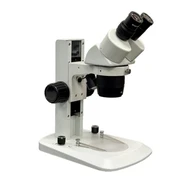
Dissecting Microscope Guide: Uses, Magnification, Parts & How to Choose One
Aug 27th 2026
A dissecting microscope, also called a stereo microscope, is designed for viewing larger, three-dimensional objects at relatively low magnification. Instead of examining thin specimens mounted on microscope slides, a dissecting microscope allows you to look at the surface of objects such as insects, plants, rocks, circuit boards, manufactured components and other solid specimens.
The combination of low magnification, a large field of view, depth perception and generous working distance also makes dissecting microscopes useful for tasks that involve manipulating an object while looking through the microscope.
Although the word "dissecting" suggests a microscope used primarily for biology, modern dissecting microscopes are used in laboratories, classrooms, manufacturing facilities, electronics work, quality control and many other applications.
If you are looking for a microscope for this type of work, browse Microscope World's dissecting microscopes or continue below to learn how they work and what to consider when choosing one.
What Is a Dissecting Microscope?
A dissecting microscope is a low-magnification optical microscope that provides a three-dimensional view of a specimen.
Unlike a compound microscope, which is primarily designed to examine thin or transparent specimens at high magnification, a dissecting microscope is generally used to examine larger objects and surface details.
One of the biggest differences is the optical system. A dissecting microscope provides two separate optical paths, one for each eye. Each eye sees the specimen from a slightly different angle. Your brain combines these two images to create depth perception and a three-dimensional view.
This makes it easier to judge height, depth, shape and surface features while examining a specimen.
Dissecting microscopes also typically provide more room between the objective lens and the specimen than a compound microscope. This working distance allows users to place tools, probes, tweezers, soldering equipment and other instruments underneath the microscope while continuing to view the object.
Is a Dissecting Microscope the Same as a Stereo Microscope?
In most situations, dissecting microscope and stereo microscope refer to the same type of microscope .
The term "dissecting microscope" became common because these microscopes are frequently used for dissecting biological specimens. The term "stereo microscope" describes the instrument's stereoscopic optical system and its ability to provide depth perception.
Today, stereo microscope is often the broader technical term because these microscopes are used for far more than dissection.
You may also see terms such as:
- Stereo dissecting microscope
- Dissection microscope
- Stereo zoom microscope
- Low-power microscope
- Inspection microscope
The exact terminology can vary based on the application and microscope configuration, but many of these systems use the same basic stereo microscope design.
What Is a Dissecting Microscope Used For?
The ability to examine solid objects in three dimensions makes dissecting microscopes useful across many industries.
Biology and Dissection
Dissecting microscopes allow students, researchers and laboratory professionals to examine entire biological specimens rather than extremely small structures within them.
Common specimens include:
- Insects
- Plants
- Seeds
- Flowers
- Small organisms
- Tissue samples
- Anatomical structures
The working distance underneath the objective also allows a user to manipulate or dissect the specimen while viewing it.
Electronics Inspection and Repair
Stereo dissecting microscopes are frequently used for working with printed circuit boards and electronic components.
Low magnification and good depth perception can help technicians inspect:
- Solder joints
- Connectors
- Components
- Wiring
- Circuit board defects
- Assembly quality
A stereo microscope also leaves enough room below the objective for soldering and other hands-on work.
Manufacturing and Quality Control
Manufacturers use dissecting microscopes to inspect parts and assemblies that are too small to examine effectively with the unaided eye but do not require the high magnification of a compound microscope.
Applications can include:
- Surface inspection
- Assembly verification
- Defect identification
- Small-part inspection
- Tool inspection
- Precision manufacturing
For larger components, a stereo microscope mounted on a boom stand or articulated arm can provide additional flexibility.
Rocks, Minerals and Materials
Geologists, materials scientists and researchers can use dissecting microscopes to examine surface structures, fractures, grains, mineral samples and other material characteristics.
The combination of a wide field of view and depth perception makes the microscope especially useful for initial visual inspection before moving to higher-magnification techniques when necessary.
Gems and Jewelry
Dissecting microscopes can also be used for examining gemstones, jewelry and other detailed objects.
Magnification makes it easier to inspect surfaces, settings and small features while maintaining enough working room to manipulate the object.
What Magnification Does a Dissecting Microscope Use?
Dissecting microscopes operate at much lower magnifications than compound microscopes.
Professional stereo microscopes commonly operate within a range of approximately 5x to 80x, depending on the microscope, eyepieces, objective system and any auxiliary lenses being used.
Educational dissecting microscopes may have simpler fixed or dual magnification options such as 10x and 30x.
This lower magnification is intentional.
When examining a circuit board, insect, flower or manufactured component, you generally want to see a reasonably large portion of the specimen while maintaining depth perception and enough working distance to interact with it.
Increasing magnification also decreases the amount of the specimen visible at one time.
Common Dissecting Microscope Magnifications
|
Magnification |
Common Applications |
|
5x-10x |
Larger specimens, sorting and general inspection |
|
10x-20x |
Biology, dissection, plants and basic assembly |
|
20x-40x |
Electronics, small parts and detailed inspection |
|
40x-80x |
Fine surface details and precision inspection |
These are general ranges. The best magnification depends on the size of your specimen and the level of detail you need to see.
More magnification is not automatically better. A lower magnification can provide a wider field of view, greater depth of field and a more useful overall view of the specimen.
How Is Dissecting Microscope Magnification Calculated?
The total magnification of a stereo dissecting microscope depends on the eyepiece and objective magnification.
For a basic system:
Eyepiece magnification × objective magnification = total magnification
For example, a microscope with 10x eyepieces and the objective set to 2x produces:
10x × 2x = 20x total magnification
Some stereo microscopes also use auxiliary lenses. In that case, the auxiliary lens becomes part of the calculation.
For example:
10x eyepiece × 2.5x objective × 1.5x auxiliary lens = 37.5x total magnification
Zoom stereo microscopes make it possible to move continuously through a range of magnifications rather than switching between only one or two preset values.
Parts of a Dissecting Microscope
Specific microscope designs vary, but most dissecting microscopes share several important components.
Eyepieces
The eyepieces, also known as ocular lenses, are the lenses you look through. Many dissecting microscopes use 10x eyepieces.
Objective Lenses
The objective system provides the initial magnification of the specimen.
On a zoom stereo microscope, the objective magnification can be adjusted continuously through a range.
Zoom or Magnification Control
Zoom microscopes have a control that allows the user to increase or decrease magnification without switching objectives.
Fixed and dual-power microscopes may use a simpler objective system with one or two available magnification levels.
Focus Control
The focus mechanism moves the microscope head or stage relative to the specimen until the image becomes sharp.
Stand
The stand supports the microscope.
Common options include compact tabletop stands, boom stands and articulated-arm stands. The right design depends heavily on the size of the specimens and the amount of workspace required.
Illumination
Many dissecting microscopes use reflected illumination from above because they are commonly used to examine opaque specimens.
Some systems also include transmitted illumination from below. Having both options can be useful when working with a variety of transparent, translucent and opaque specimens.
Trinocular Camera Port
A trinocular dissecting microscope includes a third optical port that can be connected to a microscope camera.
This can be useful for image capture, documentation, measurement, training and displaying the microscope image on a monitor.
How Does a Dissecting Microscope Work?
A dissecting microscope uses two optical paths positioned at slightly different angles.
One optical path delivers an image to the left eye, while the other delivers a slightly different image to the right eye.
Your brain combines those perspectives into a single stereoscopic image.
The concept is similar to normal human vision. Because your eyes view an object from slightly different positions, your brain can interpret differences between those views to perceive depth.
That stereoscopic effect is one of the biggest advantages of a dissecting microscope.
Why Does a Dissecting Microscope Produce a 3D Image?
A dissecting microscope produces a three-dimensional image because each eye receives a slightly different view of the specimen.
This allows the user to perceive differences in height and depth rather than seeing only a flat magnified image.
Depth perception is particularly helpful when manipulating specimens or performing precise work. A technician soldering a component, for example, needs to judge not only the location of the component but also the height and position of the soldering tool.
Types of Dissecting Microscopes
Dissecting microscopes are available in several configurations.
Fixed Magnification Dissecting Microscopes
A fixed magnification microscope provides one magnification level.
These microscopes are simple to operate and can be appropriate when the same type of specimen or task is performed repeatedly.
Dual Magnification Dissecting Microscopes
Dual magnification microscopes provide two magnification settings.
For example, a microscope may allow users to switch between 10x and 30x.
These systems are commonly used in educational environments because they provide additional flexibility without requiring a more complex zoom system.
Zoom Dissecting Microscopes
A stereo zoom microscope allows the user to move through a continuous range of magnifications.
Instead of switching directly from 10x to 30x, for example, a zoom microscope allows intermediate magnifications.
This can be particularly useful in inspection and laboratory environments where specimens vary in size or users regularly need to move between an overall view and a closer inspection.
Digital Dissecting Microscopes
A digital stereo microscope incorporates a camera or allows a microscope camera to be connected to the optical system.
The image can then be displayed on a computer or monitor.
Digital imaging can be useful for:
- Documentation
- Training
- Presentations
- Image sharing
- Measurement
- Quality control records
Binocular and Trinocular Dissecting Microscopes
A binocular microscope has two eyepieces for normal visual observation.
A trinocular microscope adds a separate camera port. This is often the better choice when digital documentation or imaging is an important part of the application.
Dissecting Microscope vs. Compound Microscope
Dissecting and compound microscopes are designed for very different types of specimens.
|
Feature |
Dissecting Microscope |
Compound Microscope |
|
Magnification |
Low to moderate |
Moderate to high |
|
Image |
3D stereoscopic view |
Primarily flat view |
|
Specimens |
Larger, solid or opaque objects |
Thin or transparent specimens |
|
Working distance |
Generally larger |
Generally smaller |
|
Sample preparation |
Often minimal |
Frequently requires slides |
|
Common uses |
Dissection, electronics, inspection |
Cells, tissues, microorganisms |
A dissecting microscope might be used to examine an insect as a whole, while a compound microscope could be used to examine cells from that organism on a prepared slide.
For a more detailed comparison, read Difference Between Compound and Dissecting Microscopes .
How to Choose a Dissecting Microscope
The best dissecting microscope depends much more on your application than on maximum magnification alone.
Start With the Application
Consider what you plan to examine and what you will be doing while looking through the microscope.
A classroom dissecting microscope has very different requirements from a microscope used for electronics repair or industrial quality control.
Choose the Right Magnification Range
Select enough magnification to reveal the details you need without unnecessarily sacrificing field of view or working distance.
If you regularly examine specimens of different sizes, a zoom microscope will usually offer more flexibility than a fixed-power system.
Consider Working Distance
Working distance is the space between the microscope's objective and the specimen when the object is in focus.
A larger working distance becomes especially important when you need to manipulate the specimen.
Applications such as dissection, soldering, assembly and repair require enough space for your hands and tools underneath the microscope.
Consider the Field of View
Field of view describes how much of the specimen is visible through the microscope.
As magnification increases, field of view generally decreases.
For applications involving larger objects, starting with a wider field of view can make it easier to locate areas of interest before increasing magnification.
Select the Right Illumination
Opaque objects generally require reflected light from above.
Transparent or translucent specimens may benefit from transmitted illumination beneath the stage.
If you expect to examine many different types of specimens, a microscope with both reflected and transmitted illumination can provide additional versatility.
Choose the Right Stand
Standard tabletop stands work well for many laboratory and educational applications.
Industrial users examining large components may benefit from boom stands or articulated-arm systems that allow the microscope head to move over a larger working area.
Decide Whether You Need Digital Imaging
If you need to capture images, share microscope views, document inspections or take measurements, consider a trinocular microscope or a system designed for digital imaging.
Dissecting Microscopes for Students vs. Professional Use
Students often do not need the same microscope configuration as an industrial laboratory or manufacturing facility.
A student dissecting microscope may use fixed or dual magnification and simple LED illumination. This can provide everything necessary for examining insects, plants, rocks and classroom specimens.
Professional applications may require:
- Continuous zoom magnification
- Higher-quality optics
- Larger working distance
- Wider fields of view
- Boom or articulated stands
- Specialized illumination
- Digital imaging
- Measurement capabilities
Rather than choosing based solely on the highest available magnification, consider the entire optical and mechanical system and how it fits the intended task.
Finding the Right Dissecting Microscope
A dissecting microscope is one of the most versatile choices for examining solid objects at low to moderate magnification. Its three-dimensional view, wide field of view and generous working distance make it useful for everything from classroom dissection to electronics inspection and precision manufacturing.
The best microscope is the one that matches the specimen and the work being performed. Magnification range, working distance, illumination, stand configuration and digital imaging requirements should all be considered before choosing a system.
Microscope World offers dissecting microscopes for educational applications as well as professional stereo microscopes for laboratory, inspection and industrial use.
Frequently Asked Questions About Dissecting Microscopes
What Is a Dissecting Microscope?
A dissecting microscope is a low-magnification microscope that uses two optical paths to provide a three-dimensional view of a specimen. It is commonly used to examine larger, solid objects rather than thin specimens mounted on slides.
What Is a Dissecting Microscope Used For?
Dissecting microscopes are used for biological dissection, plant and insect examination, electronics inspection, manufacturing, quality control, geology, jewelry inspection and other applications involving larger three-dimensional specimens.
Is a Dissecting Microscope the Same as a Stereo Microscope?
Yes. The terms dissecting microscope and stereo microscope commonly describe the same type of microscope. "Stereo microscope" refers to its stereoscopic optical system, while "dissecting microscope" refers to one of its traditional applications.
What Magnification Does a Dissecting Microscope Use?
Professional dissecting or stereo microscopes commonly operate at approximately 5x to 80x magnification, although the available range varies by microscope. Educational models may use simpler fixed or dual magnifications such as 10x and 30x.
Why Does a Dissecting Microscope Produce a 3D Image?
A dissecting microscope provides separate optical paths for the left and right eyes. Each eye sees the specimen from a slightly different angle, allowing the brain to combine the two views and perceive depth.
Can You See Cells with a Dissecting Microscope?
A dissecting microscope is generally not the best choice for examining individual cells. Its lower magnification is better suited to larger specimens and surface details. A compound microscope is usually used for viewing cells and other microscopic structures on prepared slides.
What Is the Difference Between a Dissecting Microscope and a Compound Microscope?
A dissecting microscope provides lower magnification, a three-dimensional view and more working distance for examining larger objects. A compound microscope provides much higher magnification and is generally used to examine small, thin specimens such as cells, tissues and microorganisms.
What Should I Look for When Buying a Dissecting Microscope?
Consider the magnification range, working distance, field of view, illumination, stand design and whether you need digital imaging. The best configuration depends on the size of your specimens and what you need to do while viewing them.


