
What Does Snow Look Like Under a Microscope?
Oct 1st 2026
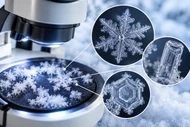
Snow may look like a soft, white powder from a distance, but snow under a microscope looks very different. Magnification reveals that snow is made up of individual ice crystals and snowflakes with geometric shapes, sharp edges, branching arms and intricate patterns.
Fresh snow can contain everything from classic six-branched snowflakes to simple hexagonal plates, columns, needles and irregular ice crystals. The exact shapes you see depend largely on the temperature and humidity conditions in which the snow formed.
Looking at snow under a microscope is a simple way to explore ice crystals, weather, symmetry and crystal formation. Because every snowfall can produce different types of crystals, there is almost always something new to see.
What Does Snow Look Like Under a Microscope?
Under a microscope, snow appears as a collection of transparent or translucent ice crystals.
Instead of the fluffy white material we see accumulating outside, magnification lets you distinguish individual crystals with clearly defined shapes and edges. Fresh snow may contain recognizable six-sided snowflakes, but it can also include much simpler ice crystals.
Depending on the snow, you might see:
- Six-sided ice crystals
- Branching snowflakes
- Thin hexagonal plates
- Long columns
- Needle-shaped crystals
- Broken or irregular crystals
- Multiple crystals joined together
Freshly fallen snow usually provides the best opportunity to see well-defined crystals. As snow sits on the ground, individual crystals can break, partially melt, refreeze and become packed together.
Is Snow Made of Snowflakes?
Snow is made of ice crystals, but not every individual piece of snow looks like the classic snowflake.
Snow begins when water vapor in the atmosphere forms ice crystals. As a crystal grows, additional water molecules become incorporated into its structure. Temperature and moisture conditions help determine how the crystal develops.
A snowflake can consist of an individual snow crystal or multiple crystals that have joined together.
This is one reason snow under a microscope can be surprising. A sample of fresh snow may contain many different crystal shapes rather than hundreds of perfect six-branched snowflakes.
What Does a Snowflake Look Like Under a Microscope?
A snowflake under a microscope can reveal a highly organized geometric structure that is difficult to appreciate with the naked eye.
Many snow crystals exhibit six-fold symmetry, with six arms or branches extending outward from a central region. With magnification, smaller side branches, ridges and other structural details become easier to see.
Some snowflakes look almost fern-like because of the many smaller branches extending from their six primary arms. Others are much simpler and may resemble a thin, six-sided plate.
Even crystals belonging to the same general type can have noticeably different patterns.
Why Do Snowflakes Have Six Sides?
The familiar six-sided structure of a snowflake comes from the molecular arrangement of ice.
A water molecule contains two hydrogen atoms and one oxygen atom. When water freezes under normal atmospheric conditions, the molecules form a crystalline structure with hexagonal symmetry.
As additional water molecules become incorporated into a growing snow crystal, this microscopic arrangement influences the larger shape of the crystal.
That is why so many snow crystals develop six sides, six points or six main branches.
Types of Snow You Can See Under a Microscope
One of the most interesting parts of viewing snow under magnification is discovering how different individual crystals can look.
Stellar Dendrites
Stellar dendrites are the classic snowflake shape. They typically have six main branches with many smaller side branches.
Their complex, tree-like patterns can produce some of the most dramatic snowflake views under a microscope.
Stellar Plates
Stellar plates are flatter snow crystals with six broad arms. They generally have less branching than stellar dendrites but still display obvious six-fold symmetry.
Hexagonal Plates
Some snow crystals form as relatively simple, flat hexagons. Under magnification, they can resemble tiny transparent six-sided plates.
Columns
Not all snow crystals are flat. Columnar snow crystals are elongated and can resemble tiny six-sided prisms.
Needles
Needle crystals are long, narrow ice crystals. Their appearance is dramatically different from the branching snowflake shape most people associate with snow.
Irregular Crystals
Snow can also contain broken, incomplete or irregularly shaped ice crystals.
This is especially common when examining snow that has already accumulated. Crystals can collide with one another, partially melt, refreeze or become damaged after reaching the ground.
Why Does Snow Look White Under Normal Conditions?
An individual snow crystal can appear transparent or translucent, yet a snow-covered yard looks white.
The difference comes from the way light interacts with a large collection of ice crystals.
When light enters snow, it encounters countless ice surfaces and air spaces. Light is repeatedly reflected and scattered in many directions. Because the visible wavelengths are broadly scattered, the snow appears white to our eyes.
Under a microscope, where you can isolate individual snow crystals, their transparent or translucent appearance becomes much easier to see.
Why Does Every Snowflake Look Different?
The shape of a snow crystal is strongly influenced by the atmospheric conditions it encounters while forming and falling.
Temperature and humidity are particularly important.
A crystal may begin growing under one set of conditions and then fall into another part of a cloud with different temperature and moisture levels. Its growth pattern can change along the way.
Even small differences in the paths traveled by two crystals can contribute to different branching patterns and structures.
This creates an enormous amount of variation among naturally occurring snow crystals.
What Microscope Is Best for Looking at Snow?
A stereo microscope, also called a dissecting microscope, is generally a practical choice for looking at snow and individual snowflakes.
Snow crystals are three-dimensional objects that do not require extremely high magnification. Stereo microscopes are designed to examine larger, solid specimens at relatively low magnification and provide a three-dimensional view. They also offer working space beneath the objective for positioning specimens.
You can learn more about how this microscope works in Microscope World's What Is a Stereo Microscope? guide.
For available options, browse Microscope World's stereo microscopes or dissecting microscopes .
What Magnification Do You Need to See Snow?
You do not need hundreds of times magnification to examine a snowflake.
Low magnification is useful because it allows you to see the overall shape of a relatively large snow crystal. You can then increase magnification to examine individual branches, edges and other details.
Many stereo microscopes operate within low magnification ranges suited to larger three-dimensional specimens. Microscope World's stereo microscope guide notes that stereo microscopes typically operate at much lower magnifications than compound microscopes.
Using too much magnification can actually make observing a snowflake more difficult because the entire crystal may no longer fit within your field of view.
How to Look at Snow Under a Microscope
The biggest challenge when viewing snow under a microscope is keeping it frozen. A warm surface, tool or indoor environment can quickly change or melt a snow crystal.
1. Prepare a Cold Collection Surface
Use a dark surface, such as black construction paper, so individual snow crystals are easier to find.
Place the material outside beforehand so it becomes cold. Fresh snow can begin melting quickly if it lands on a warm surface.
2. Cool Your Tools
Any tools that will touch the snow should also be cold.
If you plan to use a small brush or another tool to move individual crystals, allow it to cool before collecting your sample.
3. Collect Fresh Snow
Place your cold collection surface outside during active snowfall.
Freshly fallen snow gives you the best chance of finding intact crystals. Try to collect individual flakes rather than large clumps.
4. Transfer the Snow Carefully
Move the specimen to the microscope while keeping it as cold as possible. Avoid touching the snow directly with your fingers.
5. Start With Low Magnification
Begin at the microscope's lowest magnification so you can locate an individual crystal and bring it into focus.
Once you find an interesting crystal, increase magnification if you want to examine smaller features.
6. Observe or Photograph It Quickly
Snow crystals can begin changing as their temperature rises.
Observe and photograph your specimens quickly if you want to capture their original structures.
Can You Use a Compound Microscope to Look at Snow?
A compound microscope can provide much greater magnification, but it is usually not the easiest microscope for observing an entire snowflake.
Compound microscopes are generally designed for small specimens that are placed on microscope slides. Stereo microscopes provide lower magnification and more room for larger three-dimensional specimens.
Microscope World explains these differences in its What Is a Compound Microscope? article.
For observing the overall structure of a snowflake, the lower magnification and working distance of a stereo microscope are generally more practical.
Fresh Snow vs. Old Snow Under a Microscope
If you compare freshly fallen snow with snow that has been sitting on the ground, you may notice significant differences.
Fresh snow is more likely to contain intact crystals with clearly defined edges and branches.
Older snow changes over time. Individual crystals can partially melt and refreeze, become rounded, break apart or join neighboring crystals. Changes in temperature can accelerate these transformations.
Comparing fresh and older snow under a microscope can make an interesting science experiment. Collect samples at different times and examine them at the same magnification to compare their structures.
Can You Photograph Snow Under a Microscope?
Yes. Photographing snow through a microscope allows you to preserve the appearance of a crystal that may begin changing or melting within a short period of time.
A digital microscope or microscope camera can be particularly helpful when you want to capture and compare multiple snow crystals.
Microscope World offers digital microscopes and microscope cameras that allow specimens to be viewed or captured digitally.
When photographing snowflakes, start at low magnification so the entire crystal fits within the image before moving in for closer views of individual branches.
Frequently Asked Questions About Snow Under a Microscope
What does snow look like under a microscope?
Snow under a microscope appears as individual transparent or translucent ice crystals. Depending on how the snow formed, you may see branching snowflakes, hexagonal plates, columns, needles and irregular ice crystals.
What does a snowflake look like under a microscope?
A snowflake can appear as an intricate ice crystal with six sides or six primary branches. Some have elaborate branching patterns, while others have much simpler geometric shapes.
Is snow just frozen water?
Snow is composed of ice crystals made from water. Snow crystals typically form in the atmosphere as water vapor contributes to the growth of ice crystals.
Why are snowflakes six-sided?
Snowflakes commonly have six-fold symmetry because of the hexagonal crystalline structure that water molecules form in ordinary ice.
What magnification do you need to see snowflakes?
Low magnification is generally sufficient to examine the overall shape of a snowflake. A stereo microscope is useful because it provides a wide field of view while still revealing details in the crystal.
What microscope should you use to look at snow?
A stereo or dissecting microscope is generally well suited for observing snow because it provides low magnification, a three-dimensional view and working space for larger specimens.
Can you see individual snow crystals without a microscope?
Yes. Larger snow crystals can be visible to the naked eye, especially when collected on a dark surface. A microscope makes their smaller branches, edges and crystal structures easier to examine.
Explore Snow and Ice Under a Microscope
What looks like a simple blanket of white snow is actually a collection of individual ice crystals with an enormous variety of shapes and structures.
Looking at snow under a microscope can reveal hexagonal plates, columns, needles and elaborate branching snowflakes. It also provides a hands-on way to explore how temperature, moisture and crystal structure influence the natural world.
Whether you are conducting a classroom experiment, photographing snow crystals or simply curious about what a snowflake looks like under a microscope , you do not need extreme magnification to discover remarkable details hiding inside freshly fallen snow.
For this type of observation, explore Microscope World's stereo microscopes and dissecting microscopes .


