
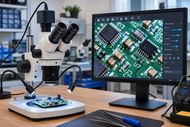
The Complete Guide to Buying a Digital Microscope
Jul 10th 2026
How to Choose the Right Model for Research, Education, Industry, and Inspection
Whether you're inspecting circuit boards, documenting biological samples, teaching students, or performing quality control, choosing the right digital microscope can significantly improve your workflow. Unlike traditional microscopes that require users to look through eyepieces, digital microscopes display magnified images on a computer monitor or built-in screen, making them easier to use, share, and document.
With so many models available, selecting the right digital microscope isn't always straightforward. Camera resolution, magnification, working distance, lighting, software, and intended application all play an important role in finding the best system for your needs.
This guide explains the different types of digital microscopes, the features that matter most, and how to choose the right model for your application.
Quick Navigation
What Is a Digital Microscope?
A digital microscope uses a camera to capture a magnified image of a specimen and display it on a monitor, computer, or built-in LCD screen. Instead of viewing through eyepieces, users can observe, capture, measure, and share images digitally.
Many digital microscopes also allow users to:
- Capture high-resolution images
- Record video
- Take measurements using software
- Annotate images
- Share live images with students or colleagues
- Save inspection records for quality control or documentation
Digital microscopes are used in a wide variety of industries, including:
- Electronics manufacturing
- Medical and biological research
- Education
- Industrial inspection
- Quality assurance
- Materials science
- Forensics
- Jewelry and gemology
- Entomology
If you're looking to browse available systems, Microscope World offers a wide selection of digital microscopes designed for professional, educational, and industrial applications.
How Does a Digital Microscope Work?
A digital microscope combines traditional microscope optics with a digital imaging sensor. Light passes through or reflects from the specimen, travels through the objective lens, and reaches the camera sensor. The sensor converts the optical image into a digital signal that is displayed on a monitor.
Most systems include several key components:
Objective Lens
The objective lens determines the optical magnification and image quality. Higher-quality optics produce sharper images with better color accuracy and improved edge-to-edge clarity.
Digital Camera Sensor
Instead of an eyepiece, the image is captured by a digital sensor. Depending on the microscope, sensors may range from a few megapixels to over 20 megapixels for advanced imaging applications.
Display Device
Images may be viewed using:
- A computer
- An HDMI monitor
- A built-in LCD display
- A tablet or mobile device (on select models)
Software
Many professional systems include software that allows users to:
- Measure distances
- Count particles
- Capture still images
- Record video
- Add annotations
- Export reports
- Calibrate measurements
These capabilities make digital microscopes valuable for documentation, collaboration, and repeatable inspections.
Types of Digital Microscopes
Not every digital microscope is designed for the same purpose. Understanding the major categories can help narrow your search.
USB Digital Microscopes
USB digital microscopes connect directly to a computer and are popular for education, hobby use, and light inspection work.
They typically offer:
- Easy plug-and-play setup
- Image and video capture
- Compact size
- Affordable pricing
USB microscopes are commonly used for classroom demonstrations, coin collecting, insect observation, and basic electronics inspection.
Digital Stereo Microscopes
Digital stereo microscopes provide true three-dimensional viewing with a camera integrated into the optical system. Because they offer greater working distance than compound microscopes, they are well suited for inspecting larger objects.
Common applications include:
- PCB inspection
- Electronics assembly
- Manufacturing
- Soldering
- Medical device inspection
- Quality control
Microscope World offers a large selection of stereo microscopes that can be configured with digital cameras for documentation and inspection.
Digital Compound Microscopes
Digital compound microscopes are designed for viewing thin specimens at higher magnifications.
They're commonly used for:
- Cell biology
- Histology
- Microbiology
- Clinical laboratories
- Research
- Education
These systems combine laboratory-grade optics with digital imaging, making them ideal for capturing detailed images of slides and biological specimens.
Industrial Digital Microscopes
Industrial digital microscopes are built for demanding inspection environments.
These systems often include:
- High-resolution cameras
- Long working distances
- Precision stands
- Measurement software
- Advanced lighting options
- Large zoom ranges
Industries that commonly use industrial digital microscopes include:
- Aerospace
- Automotive manufacturing
- Semiconductor production
- Medical device manufacturing
- Precision machining
- Quality assurance laboratories
For many industrial users, accurate measurements and image documentation are just as important as magnification.
LCD Digital Microscopes
Some digital microscopes feature an integrated LCD display, allowing users to view specimens without connecting to a separate computer.
These models are popular for:
- Education
- Classroom demonstrations
- Field inspections
- Portable workstations
- Quick quality checks
Because multiple people can view the screen simultaneously, LCD microscopes are often useful in collaborative environments.
Why Professionals Choose Digital Microscopes
Digital microscopes offer several advantages over traditional optical microscopes.
Easier Collaboration
Instead of one person looking through an eyepiece, everyone can view the same live image on a monitor.
This is especially valuable in:
- Classrooms
- Laboratories
- Manufacturing facilities
- Training environments
Better Documentation
Many industries require photographic documentation.
Digital microscopes make it easy to:
- Save inspection images
- Record videos
- Create reports
- Document defects
- Maintain quality records
Reduced Eye Fatigue
Long inspection sessions can become uncomfortable when continuously using eyepieces.
Viewing specimens on a monitor allows users to work in a more ergonomic position, reducing fatigue during extended use.
Accurate Measurements
Many digital microscope systems include calibrated measurement software capable of measuring:
- Length
- Diameter
- Area
- Angles
- Radius
- Surface features
These tools are especially valuable in manufacturing and quality assurance environments.
Easy Image Sharing
Researchers, educators, and technicians can quickly share captured images with colleagues, customers, or students without requiring everyone to gather around a single microscope.
Digital vs. Traditional Optical Microscopes
Digital microscopes and traditional optical microscopes each have their strengths. The best choice depends on how you'll use the microscope and whether documentation, collaboration, or image analysis are part of your workflow.
|
Feature |
Digital Microscope |
Traditional Optical Microscope |
|
Live image on monitor |
✓ |
No |
|
Image and video capture |
✓ |
Requires camera attachment |
|
Measurements |
✓ (with software) |
Limited |
|
Multiple viewers |
✓ |
One user at a time |
|
Documentation |
Excellent |
Good with accessories |
|
Portability |
Varies |
Varies |
|
Best for collaboration |
✓ |
Limited |
Traditional microscopes remain an excellent choice for many laboratory applications, particularly when users prefer direct optical viewing. However, digital microscopes provide additional flexibility for recording images, sharing observations, and performing measurements, making them increasingly popular across research, education, and industry.
Choosing the Right Digital Microscope for Your Application
The best digital microscope isn't necessarily the one with the highest magnification or largest camera sensor. It is the one designed for the type of work you'll perform most often.
Before choosing a microscope, consider these questions:
- What are you inspecting?
- How large is the object?
- Do you need measurements?
- Will multiple people view the image?
- Do you need to save photos or videos?
- Will the microscope stay in one location or travel between workstations?
Here are some common applications and the features that matter most.
Education
Schools, colleges, and universities often need microscopes that are easy to use while allowing instructors to display images to an entire classroom.
Look for:
- Simple software
- USB or HDMI connectivity
- Reliable optics
- Durable construction
- Easy image capture
A digital microscope allows instructors to demonstrate techniques without students crowding around a single microscope.
If you're purchasing for a school or university, our College and University Microscope Buying Guide provides additional recommendations for educational labs.
Electronics and PCB Inspection
Electronics professionals often need to inspect solder joints, connectors, traces, and components.
The ideal system should provide:
- Long working distance
- Stereo viewing
- Adjustable LED lighting
- Smooth zoom controls
- High-resolution camera
- Stable stand
These features make it easier to perform repairs while maintaining excellent image quality.
Professionals working in electronics often choose systems from our Electronics & PCB Inspection Microscopes collection, paired with a digital camera for documentation.
Manufacturing and Quality Control
Manufacturers rely on digital microscopes to inspect machined parts, molded components, welds, coatings, and finished products.
Important features include:
- Measurement software
- Consistent lighting
- High image quality
- Repeatable positioning
- Durable construction
In quality assurance, captured images often become part of inspection records, making software capabilities just as important as the optics.
Biological Research
Researchers studying cells, microorganisms, tissues, or prepared slides typically require higher magnification and excellent optical performance.
A digital compound microscope allows researchers to:
- Capture publication-quality images
- Share findings with colleagues
- Record video
- Document experiments
- Perform image analysis
Our selection of biological lab microscopes includes models suitable for teaching laboratories, clinical environments, and advanced research.
Industrial Inspection
Industrial users often inspect:
- Precision machined components
- Medical devices
- Aerospace parts
- Plastics
- Surface finishes
- Metal components
For these applications, stability and image quality are often more important than extremely high magnification.
Many industrial inspections benefit from larger working distances that allow technicians to manipulate parts while viewing them under magnification. View our collection of industrial inspection microscopes .
Gemology and Jewelry
Gemologists need excellent color accuracy and three-dimensional viewing when grading gemstones or inspecting jewelry.
A gemological microscope with a digital camera allows professionals to:
- Photograph gemstones
- Document inclusions
- Share images with clients
- Record inventory
Features That Matter Most
When comparing digital microscopes, these specifications will have the greatest impact on image quality and usability.
Optical Magnification vs. Digital Magnification
This is one of the most misunderstood specifications.
Many inexpensive digital microscopes advertise magnification levels of 1,000x or more. In reality, these numbers often rely heavily on digital zoom.
Digital zoom simply enlarges the image after it has been captured. It does not reveal additional detail.
Optical magnification, produced by the microscope's lenses, is what determines how much detail you can actually resolve.
When evaluating microscopes, prioritize:
- High-quality optics
- Camera quality
- Sensor performance
These factors have a much greater effect on image quality than inflated digital magnification claims.
Camera Resolution
Resolution determines how much detail the camera can capture.
Higher megapixel ratings generally produce larger images, but image quality also depends on the optics and sensor.
As a general guideline:
|
Resolution |
Best For |
|
2-5 MP |
Education and routine documentation |
|
5-10 MP |
Industrial inspection and laboratories |
|
10 MP+ |
Research, publication, detailed analysis |
A well-designed 5 MP camera paired with excellent optics often produces better images than a higher-megapixel camera with lower-quality lenses.
Working Distance
Working distance refers to the space between the objective lens and the specimen.
This becomes especially important when inspecting larger objects or performing work under the microscope.
Longer working distances make it easier to:
- Repair electronics
- Solder circuit boards
- Inspect mechanical parts
- Manipulate samples with tools
Stereo microscopes generally provide significantly more working distance than compound microscopes.
Field of View
Field of view describes how much of the specimen is visible at one time.
A wider field of view allows users to:
- Locate features more quickly
- Inspect larger components
- Reduce repositioning
Higher magnification narrows the field of view, making navigation more difficult.
Finding the right balance between magnification and field of view is often more important than simply choosing the highest magnification available.
Image Sensor Quality
The camera sensor influences:
- Color accuracy
- Low-light performance
- Dynamic range
- Noise levels
- Overall image clarity
Professional systems typically use higher-quality sensors that deliver more accurate and consistent images, especially during extended use.
Lighting Options
Good lighting is essential for producing sharp, detailed images.
Common illumination options include:
LED Ring Lights
Provide even illumination for routine inspection.
Adjustable LED Lighting
Allows brightness to be optimized for different materials and surfaces.
Transmitted Lighting
Used when viewing transparent specimens such as biological slides.
Reflected Lighting
Ideal for opaque objects including metals, plastics, electronics, and minerals.
Selecting the correct lighting often has as much impact on image quality as choosing the right microscope itself.
Software Features That Add Long-Term Value
The software included with a digital microscope can greatly expand what you can do beyond simply viewing magnified images. While software capabilities vary by manufacturer and model, professional systems often include tools that improve documentation, collaboration, and analysis.
When comparing digital microscopes, consider whether the software includes:
- Image capture
- Video recording
- Measurement tools
- Scale calibration
- Annotations and labels
- Side-by-side image comparisons
- Image stitching
- Report exporting
If you're documenting inspections, creating research records, or generating reports for customers, these features can save significant time.
Common Digital Microscope Buying Mistakes
Choosing a digital microscope involves more than comparing magnification numbers. Here are some of the most common mistakes buyers make and how to avoid them.
Buying Based Only on Magnification
Magnification is often the first specification buyers notice, but it rarely tells the whole story.
A microscope with high-quality optics and a quality camera will usually produce better images than one advertising extremely high digital magnification.
Instead of asking, "What's the highest magnification?" ask, "Will this microscope let me clearly see what I need to inspect?"
Ignoring Working Distance
Many buyers don't realize how important working distance is until they begin using the microscope.
If you'll be repairing electronics, inspecting manufactured parts, or handling specimens beneath the microscope, you'll want enough room to comfortably work under the objective.
Choosing the Wrong Microscope Type
Different applications require different microscope designs.
For example:
- Inspecting a circuit board? A stereo microscope is usually the better choice.
- Viewing cells or tissue samples? A compound microscope is more appropriate.
- Teaching a classroom? A digital microscope with easy image sharing may be ideal.
Choosing the correct style of microscope is often more important than choosing the highest-end model.
Overlooking Software Compatibility
Before purchasing, verify that any required software is compatible with your operating system and workflow.
Questions to ask include:
- Does it support Windows or macOS?
- Can images be exported in standard formats?
- Does it include measurement capabilities?
- Is software included or purchased separately?
Forgetting Future Needs
Many organizations purchase a microscope that meets today's requirements but leaves little room for future growth.
Consider whether you may eventually want to add:
- A higher-resolution camera
- Different objective lenses
- Additional lighting
- Measurement software
- Specialized accessories
A modular system can provide greater long-term value than replacing the entire microscope later.
Recommended Digital Microscopes by Application
Instead of looking for one "best" digital microscope, start by identifying the work you'll perform most often.
|
Application |
Recommended Microscope Type |
|
Classroom instruction |
USB or LCD Digital Microscope |
|
Biology and laboratory work |
Digital Compound Microscope |
|
Electronics repair |
Digital Stereo Microscope |
|
PCB inspection |
Digital Stereo Microscope |
|
Manufacturing |
Industrial Digital Microscope |
|
Quality assurance |
Digital Stereo or Industrial Microscope |
|
Gemology |
Stereo Microscope with Digital Camera |
|
Materials science |
Compound or Industrial Digital Microscope |
If you're still deciding which system fits your needs, browse Microscope World's complete collection of Digital Microscopes , where you can compare models from leading manufacturers based on your application and budget.
Why Buy a Digital Microscope from Microscope World?
Choosing the right microscope is about more than comparing specifications. Having access to knowledgeable guidance before and after your purchase can help ensure you select equipment that meets your needs.
For more than two decades, Microscope World has supplied microscopes to:
- Universities and schools
- Research laboratories
- Manufacturers
- Medical facilities
- Government organizations
- Industrial inspection professionals
Rather than offering a single house brand, Microscope World carries products from respected manufacturers, including:
This allows customers to compare solutions from multiple manufacturers instead of being limited to a single product line.
In addition to an extensive catalog, Microscope World provides educational resources that help buyers understand microscope technologies, compare features, and make informed purchasing decisions before investing in new equipment.
What's Next
If you've narrowed down the type of microscope you need but are still comparing specific models, the next step is to evaluate the features that matter most for your application. Start by browsing our selection of Digital Microscopes.
Frequently Asked Questions About Digital Microscopes
What is the difference between a digital microscope and a traditional microscope?
A digital microscope uses a built-in camera to display magnified images on a computer monitor or LCD screen rather than through eyepieces. This makes it easier to capture images, record video, share live views with others, and perform measurements using software. Traditional optical microscopes rely on direct viewing through eyepieces.
What can a digital microscope be used for?
Digital microscopes are used in a wide range of applications, including:
- Electronics and PCB inspection
- Manufacturing and quality control
- Biological and medical research
- Education
- Materials science
- Forensics
- Gemology and jewelry inspection
- Entomology
The best microscope depends on the type of specimens or objects you'll be examining.
Are digital microscopes good for professional use?
Yes. Professional-grade digital microscopes are widely used in laboratories, manufacturing facilities, universities, and research institutions. Many include high-quality optics, advanced imaging sensors, measurement software, and documentation tools designed for demanding applications.
What magnification do I need?
The right magnification depends on your application.
- 10x to 40x: Larger objects, quality control, assembly work
- 40x to 100x: Electronics inspection and general laboratory work
- 100x to 400x: Biological samples and routine microscopy
- 400x and above: Microbiology, research, and detailed specimen analysis
Keep in mind that optical quality is generally more important than simply choosing the highest advertised magnification.
Is higher camera resolution always better?
Not necessarily.
While higher-resolution cameras capture larger images, image quality also depends on the optics, sensor quality, lighting, and software. A well-designed 5 MP camera with premium optics can often outperform a higher-megapixel camera paired with lower-quality lenses.
Can digital microscopes take measurements?
Many professional digital microscopes include software that allows users to measure distances, angles, diameters, areas, and other dimensions after proper calibration.
Measurement capabilities are particularly useful in manufacturing, engineering, quality assurance, and research.
Can I record photos and videos on a digital microscope?
Most digital microscopes allow users to capture still images and record video directly to a connected computer or storage device. This is valuable for documentation, presentations, training, inspections, and research records.
Do digital microscopes work without a computer?
Some models do.
LCD digital microscopes include an integrated display, allowing you to view specimens without connecting to a computer. Other models connect through USB or HDMI and require an external display.
What's the best digital microscope for electronics repair?
For electronics assembly, soldering, and PCB inspection, a digital stereo microscope is usually the best choice because it provides:
- Greater working distance
- Three-dimensional viewing
- Excellent depth perception
- Room to work beneath the microscope
Can multiple people view the image at the same time?
Yes.
Because digital microscopes display images on a monitor, projector, or large display, they are ideal for classrooms, laboratories, training sessions, and collaborative inspections.
Are digital microscopes suitable for biological research?
Yes, provided you select the appropriate type of microscope.
Digital compound microscopes are commonly used for:
- Cell biology
- Histology
- Microbiology
- Clinical laboratories
- University research
How long do digital microscopes last?
A quality digital microscope can provide many years of reliable service with proper care and routine maintenance. Professional-grade systems are built for long-term use and often allow components such as cameras or accessories to be upgraded over time.
Digital Microscope Buying Checklist
Before making your purchase, ask yourself these questions:
✓ What will I be inspecting most often?
✓ Do I need a stereo microscope or a compound microscope?
✓ What level of magnification is actually required?
✓ Will I need to capture photos or record video?
✓ Is measurement software important?
✓ How much working distance do I need?
✓ Will multiple people need to view the specimen?
✓ Is a computer available, or would an LCD display be more convenient?
✓ Do I need room to expand the system with additional cameras or accessories?
Answering these questions before comparing models can help narrow your options and ensure you choose a microscope that fits both your current and future needs.
Choosing the Right Digital Microscope
A digital microscope is an investment in better imaging, documentation, and decision-making. Whether you're teaching students, inspecting manufactured components, conducting research, or performing quality control, selecting the right system begins with understanding your application and the features that matter most.
Rather than focusing on a single specification such as magnification, consider the complete system, including optics, camera quality, lighting, software, working distance, and ergonomics. These factors have a greater impact on day-to-day performance and the quality of the images you'll capture.
Microscope World offers a wide selection of digital microscopes from trusted manufacturer brands to support applications ranging from education and laboratory research to industrial inspection and advanced manufacturing. Explore our full collection of Digital Microscopes to compare models or contact our team if you'd like assistance selecting the right microscope for your application.


