
Stereo Microscopy for Material Analysis: When to Use It for Microstructure Evaluation, Surface Inspection, and Failure Analysis
Jun 12th 2026
In materials science, manufacturing, and quality control, understanding the characteristics of a material often begins with visual inspection. Before researchers move to high-magnification imaging techniques such as metallurgical microscopy or scanning electron microscopy (SEM), they frequently rely on stereo microscopes to evaluate samples, identify defects, and determine the next steps in their analysis workflow.
Stereo microscopy offers a unique combination of magnification, depth perception, and ease of use that makes it valuable for examining a wide range of materials. From fracture surfaces and welds to composites and additively manufactured components, stereo microscopes provide rapid insight into surface features and structural characteristics that may not be visible to the naked eye.
However, while stereo microscopes are highly effective for many forms of material analysis, they are not designed to reveal the fine microstructural details required for advanced metallurgical studies. Understanding where stereo microscopy excels, and where other imaging techniques become necessary, helps researchers, engineers, and quality control professionals select the right tool for the job.
This guide explores the role of stereo microscopy in material analysis, including its capabilities, limitations, and the applications where it delivers the greatest value.
What Is Stereo Microscopy?
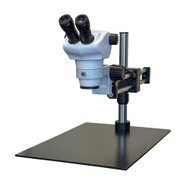
A stereo microscope, sometimes called a dissecting microscope, uses two separate optical paths to create a three-dimensional view of a specimen. Unlike compound microscopes, which prioritize high magnification, stereo microscopes are designed to provide lower magnification ranges combined with exceptional depth perception and a large working distance.
Typical stereo microscopes operate between 5x and 80x magnification, although some advanced systems can extend beyond this range with supplemental optics.
The key advantages of stereo microscopy include:
- True three-dimensional visualization
- Large field of view
- Extended working distance
- Minimal sample preparation requirements
- Easy manipulation of specimens during observation
- Excellent imaging of surface features and topography
These characteristics make stereo microscopes particularly useful for material inspection, failure analysis, and preliminary evaluation of samples before more advanced testing methods are employed.
Understanding Microstructure Analysis
Microstructure analysis involves examining the internal structure of materials at magnifications sufficient to reveal grains, phases, inclusions, voids, and other microscopic features.
Researchers use microstructure analysis to evaluate:
- Grain size and distribution
- Phase transformations
- Heat treatment effects
- Material defects
- Inclusion content
- Corrosion damage
- Manufacturing quality
Many of these features exist at scales beyond the capabilities of stereo microscopes. For detailed microstructural evaluation, polished and etched samples are typically examined using metallurgical microscopes or electron microscopy systems.
Despite this limitation, stereo microscopes remain an important part of the microstructure analysis workflow.
When Stereo Microscopy Is Useful for Microstructure Evaluation
Although stereo microscopes cannot reveal individual grains in most metals, they provide valuable information before and after detailed microstructural examination.
Sample Preparation Inspection
Proper sample preparation is critical for accurate microstructural analysis. Stereo microscopes are commonly used to inspect samples during cutting, mounting, grinding, and polishing processes.
Researchers can quickly identify:
- Scratches
- Surface contamination
- Improper polishing
- Edge rounding
- Preparation artifacts
Detecting these issues early helps prevent inaccurate results during subsequent metallurgical analysis.
Macrostructure Examination
Many material characteristics can be evaluated at relatively low magnifications.
Examples include:
- Weld penetration patterns
- Casting defects
- Segregation zones
- Crack propagation paths
- Heat-affected zones
- Porosity clusters
These larger-scale features often provide valuable context before detailed microstructural examination begins.
Fracture Surface Evaluation
One of the most common uses of stereo microscopy in materials science is fracture analysis.
Engineers frequently examine failed components under a stereo microscope to identify:
- Crack origins
- Fracture direction
- Impact damage
- Fatigue features
- Corrosion-related failures
- Overload fractures
The microscope's three-dimensional imaging capability allows analysts to observe surface contours and fracture morphology that can help determine the cause of failure.
Surface Inspection Applications
Stereo microscopy excels in evaluating material surfaces across numerous industries.
Manufacturing Quality Control
Quality control departments use stereo microscopes to inspect manufactured parts for:
- Surface defects
- Burrs
- Cracks
- Scratches
- Tool marks
- Coating irregularities
Because inspections can be performed quickly with little or no sample preparation, stereo microscopy is well suited for production environments.
Additive Manufacturing
The rapid growth of additive manufacturing has increased demand for effective inspection methods.
Stereo microscopes are commonly used to assess:
- Layer quality
- Surface roughness
- Incomplete fusion
- Support structure removal
- Powder residue
- Dimensional consistency
These evaluations help manufacturers identify production issues before parts move to more advanced testing stages.
Composite Materials
Composite structures often contain complex surface features that benefit from three-dimensional imaging.
Applications include inspection of:
- Fiber orientation
- Delamination
- Matrix cracking
- Void formation
- Impact damage
The depth perception provided by stereo microscopy allows analysts to visualize surface damage more effectively than many conventional imaging methods.
Stereo Microscopy in Failure Analysis
Failure analysis often begins with a visual examination of the failed component.
Stereo microscopes serve as a critical first step because they allow investigators to study fracture surfaces without altering the evidence.
Common failure analysis applications include:
- Aerospace component failures
- Automotive part failures
- Electronic component damage
- Industrial equipment breakdowns
- Structural material investigations
By identifying fracture origins and damage patterns, analysts can determine which areas require more detailed examination using higher-resolution techniques.
Limitations of Stereo Microscopy
Despite its versatility, stereo microscopy has important limitations that users should understand.
Limited Magnification
Most stereo microscopes cannot achieve the magnification levels needed to observe fine microstructural details.
Individual grains, precipitates, and phase boundaries often require significantly higher magnification than stereo systems can provide.
Surface-Focused Imaging
Stereo microscopes primarily reveal surface characteristics.
Internal structures generally cannot be examined unless the sample is sectioned and prepared appropriately.
Lower Resolution Compared to Metallurgical Microscopes
While stereo microscopes provide excellent depth perception, they do not offer the resolution necessary for advanced metallurgical investigations.
For detailed studies of grain structure, inclusions, or phase composition, metallurgical microscopes or electron microscopes are typically required.
Stereo Microscopes vs. Metallurgical Microscopes
Choosing between a stereo microscope and a metallurgical microscope depends on the specific goals of the analysis.
Stereo microscopes are best for:
- Surface inspection
- Fracture analysis
- Quality control
- Sample preparation verification
- Macrostructure evaluation
Metallurgical microscopes are best for:
- Grain structure analysis
- Phase identification
- Inclusion evaluation
- Heat treatment studies
- Detailed microstructural characterization
In many laboratories, both instruments play complementary roles within the same workflow.
Best Industries for Stereo Microscopy in Material Analysis
Stereo microscopes are widely used across multiple sectors, including:
- Materials science research
- Metallurgy laboratories
- Aerospace manufacturing
- Automotive engineering
- Electronics manufacturing
- Additive manufacturing
- Medical device production
- Industrial quality assurance
Their combination of speed, versatility, and ease of use makes them valuable tools wherever material inspection is required.
Choosing the Right Microscopy Technique for Material Analysis
Stereo microscopy occupies an important position in modern material analysis. While it cannot replace metallurgical microscopes or electron microscopy for detailed microstructure characterization, it provides rapid, three-dimensional visualization of surfaces, defects, fractures, and macrostructural features.
For quality control professionals, engineers, and researchers, stereo microscopes often serve as the first and most efficient step in evaluating materials. Their ability to reveal critical surface information with minimal preparation makes them indispensable for failure analysis, manufacturing inspection, and sample preparation workflows.
By understanding both the strengths and limitations of stereo microscopy, organizations can build more effective inspection processes and select the appropriate imaging techniques for each stage of material analysis.


