
Inverted vs. Upright Microscope: Which Is Right for Your Lab?
Jun 17th 2026
When equipping a research lab, clinical facility, or industrial quality control environment, few decisions carry more weight than choosing the right microscope configuration. Inverted and upright microscopes are both workhorses of modern science — but they are built for fundamentally different tasks. Choose the wrong one and you'll find yourself fighting your equipment every day.
This guide breaks down the core differences, the applications each excels at, and the questions you should be asking before you buy.
What Is an Upright Microscope?
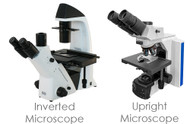
An upright microscope is the configuration most people picture when they think "microscope." The light source sits below the stage, the objective lenses sit above it, and the sample is illuminated from underneath and viewed from the top.
Upright microscopes are the standard platform for fixed, stained, and sectioned specimens — the kind mounted on glass slides. They're the backbone of histology labs, pathology departments, university biology courses, and any workflow that involves preparing samples before viewing them.
Upright microscopes excel at:
- Histological sections and tissue slides
- Stained blood smears and clinical samples
- Fixed and embedded specimens
- Material science and metallurgy (reflected light models)
- General educational and research applications
What Is an Inverted Microscope?
An inverted microscope flips the configuration: the objective lenses are positioned below the stage, and the light source is above it. The sample sits on top of an open stage, allowing researchers to work with large, bulky containers: petri dishes, multi-well plates, flasks, and culture vessels, that would never fit under the tight clearance of an upright system.
This makes the inverted microscope the default choice in cell biology, tissue culture, and any live-cell application where you need to observe specimens in their natural, unperturbed state.
Inverted microscopes excel at:
- Live cell culture and observation in flasks or dishes
- Embryology and IVF applications
- Stem cell research
- Drug discovery and high-content screening
- Microinjection and micromanipulation
- Organoid and 3D culture systems
Key Differences Between an Inverted and Upright Microsocpe
|
Feature |
Upright Microscope |
Inverted Microscope |
|
Objective position |
Above stage |
Below stage |
|
Light source position |
Below stage |
Above stage |
|
Typical sample format |
Glass slides |
Petri dishes, flasks, well plates, large samples |
|
Sample preparation |
Fixed / stained |
Live or minimally processed |
|
Working distance |
Generally shorter |
Longer (accommodates vessel depth) |
|
Stage clearance |
Limited |
Open, accommodates large vessels |
|
Typical applications |
Histology, pathology, materials |
Cell culture, IVF, live imaging |
|
Footprint |
Compact |
Larger (due to inverted design) |
Choosing by Application
Cell Biology and Live Cell Imaging → Inverted
If your lab works with cells growing in culture, the inverted microscope is almost always the right answer. Cells growing on the bottom of a flask or dish are observed through the transparent base — the inverted configuration makes this possible without disturbing or transferring the sample. This is critical for time-lapse imaging, monitoring confluency, checking for contamination, or performing live-cell fluorescence assays.
Histology, Pathology, and Clinical Work → Upright
Fixed tissue sections, biopsies, and clinical slides are prepared specifically for upright microscopy. High numerical aperture objectives, oil immersion capability, and precision stage mechanics make upright systems ideal for the high-resolution examination of stained specimens. Hospital labs, pathology departments, and university histology courses are almost universally built around upright platforms.
Fluorescence Microscopy → Depends on Your Sample
Both configurations support fluorescence imaging, and the right choice depends on sample type. Upright fluorescence microscopes are well-suited to fixed, stained tissue sections. Inverted fluorescence systems (including epifluorescence and confocal configurations) are the standard for live-cell fluorescence work — observing GFP-tagged proteins, running calcium imaging experiments, or monitoring fluorescent markers in real time without removing cells from their growth environment.
IVF and Embryology → Inverted
Assisted reproductive technology (ART) labs rely almost exclusively on inverted microscopes. Oocytes and embryos are handled and observed in culture dishes — a format that demands the open stage and long working distance only an inverted system provides. Micromanipulation setups (for ICSI, for example) are also built around inverted platforms.
Industrial Quality Control and Materials Science → Upright (Usually)
Reflected light upright microscopes are the standard tool for metallurgical analysis, semiconductor inspection, and surface quality control. However, industrial digital microscopes with inverted-style configurations are gaining ground in applications where samples are too large or irregular for a traditional upright stage.
What About Confocal and Advanced Imaging Systems?
High-end confocal and widefield fluorescence systems are available in both inverted and upright configurations, but the inverted platform dominates in modern research settings. The reasons are practical: most confocal work involves live cells or thick tissue on open dishes, incubation chambers, or perfusion systems — all of which need the clearance and accessibility of an inverted design. Upright confocal systems remain important for electrophysiology (patch-clamp) applications where researchers need top-side access to the sample during imaging.
Questions to Ask Before You Buy
Getting the configuration right is only the first step. Here are the questions every lab should work through before committing to a system:
1. What is your primary sample format? Glass slides point to upright. Dishes, flasks, and multi-well plates point to inverted. If you use both regularly, you may need both or a highly flexible modular system.
2. Are you imaging live samples or fixed ones? Live imaging almost always calls for an inverted system with appropriate environmental control accessories (heated stages, CO₂ chambers). Fixed samples are typically better served by upright systems.
3. What objectives do you need? Long working distance objectives are critical for inverted microscopy, especially when imaging through the bottom of thick culture vessels. Confirm objective compatibility and working distance specifications before purchasing.
4. Will you be doing fluorescence imaging? Both platforms support fluorescence, but the filter sets, light sources, and camera systems differ. If fluorescence is central to your workflow, discuss your specific fluorophores and imaging requirements with a specialist.
5. What is your space and budget? Inverted microscopes generally have a larger footprint and — especially for research-grade systems with cameras, stages, and illumination — a higher entry price. Build your budget around the full system, not just the stand.
6. What will you need in two to five years? Modular, upgradeable platforms from reputable manufacturers protect your investment. A system that can grow from basic transmitted light to motorized fluorescence to confocal — without replacing the entire stand — is worth the higher upfront cost.
Can One Microscope Do Both?
In short: not really, not well. While some manufacturers offer hybrid or "combination" configurations, and while accessories can extend the capability of either type, inverted and upright microscopes are optimized for fundamentally different workflows. Labs with genuinely diverse needs — a pathology component alongside a cell culture program, for example — typically maintain both configurations.
The good news is that as research-grade systems have become more modular, the cost and footprint of building out a two-microscope lab has become more manageable than it once was.
Making the Right Call for Your Lab
Choosing between an inverted and upright microscope comes down to one core question: what does your sample look like, and how is it contained?
- Slides and fixed specimens → upright
- Dishes, flasks, and live cells → inverted
- Both → plan for both
Beyond the configuration, the most important decision is the quality of the optics, the modularity of the platform, and the support behind the system. A microscope is a long-term investment in your lab's productivity and the quality of your data.
Explore Inverted Microscopes at Microscope World
Microscope World carries a curated selection of research-grade and clinical inverted microscopes — from entry-level systems for routine cell culture observation to fully configured fluorescence and digital imaging platforms for demanding research environments.
Not sure which system fits your workflow? Our team works with universities, biotech companies, hospitals, and industrial labs every day. Contact us and we'll help you find the right solution.


