
Microscopy in Semiconductor Failure Analysis: Techniques, Tools, and Best Practices
Jan 16th 2026
Semiconductor failure analysis plays a critical role in ensuring device reliability, improving yield, and reducing costly production defects. As semiconductor designs become smaller, denser, and more complex, microscopy has become one of the most essential tools for identifying, isolating, and understanding failure mechanisms at the micro- and nanoscale.
This guide explores how microscopy is used in semiconductor failure analysis, the most common techniques and tools involved, and best practices for obtaining accurate, actionable results.
What Is Semiconductor Failure Analysis?
Semiconductor failure analysis is the systematic process of investigating why a device, component, or integrated circuit does not perform as intended. Failures can occur during fabrication, assembly, testing, or field use and may stem from:
• Process defects
• Material contamination
• Design flaws
• Electrical overstress
• Thermal or mechanical stress
• Wear-out over time
Microscopy enables engineers to visually inspect, measure, and analyze these failures at resolutions not possible with the naked eye or traditional inspection tools.
Why Microscopy Is Essential in Semiconductor Failure Analysis
Modern semiconductor features are measured in nanometers. Many critical defects—such as voids, cracks, delamination, electromigration, and particle contamination—are invisible without advanced imaging techniques.
Microscopy allows failure analysts to:
• Locate the exact site of failure
• Examine surface and subsurface defects
• Identify material inconsistencies
• Correlate visual evidence with electrical test data
• Validate process changes and corrective actions
Without microscopy, failure analysis would rely heavily on assumptions rather than evidence.
Key Microscopy Techniques Used in Semiconductor Failure Analysis
Optical Microscopy
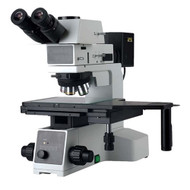
Optical microscopy is often the first step in failure analysis. It provides a fast, non-destructive way to inspect die surfaces, bond wires, solder joints, and packaging defects.
Common uses include:
• Initial defect localization
• Surface contamination inspection
• Crack and delamination detection
• Assembly and packaging evaluation
While limited by optical resolution, modern digital optical microscopes with advanced lighting and contrast techniques remain invaluable for screening and documentation.
Scanning Electron Microscopy (SEM)
SEM is one of the most widely used tools in semiconductor failure analysis due to its high resolution and depth of field.
SEM enables:
• Imaging of nanoscale structures
• Identification of voids, shorts, and opens
• Inspection of metal lines and vias
• Detection of electromigration damage
SEM is particularly effective for examining failure sites after decapsulation or cross-sectioning and is often paired with elemental analysis techniques.
Focused Ion Beam (FIB) Microscopy
FIB systems allow analysts to precisely mill, cross-section, or expose internal structures of semiconductor devices.
Key applications include:
• Targeted cross-sectioning of failure sites
• Circuit edit and probing
• Layer-by-layer analysis
• Defect isolation for SEM or TEM imaging
FIB microscopy is essential for advanced node analysis where accuracy and localization are critical.
Transmission Electron Microscopy (TEM)
TEM provides atomic-level resolution and is used when failure mechanisms occur at extremely small scales.
TEM is used to analyze:
• Thin film integrity
• Crystal defects
• Interface failures
• Grain boundaries and dislocations
Due to sample preparation complexity and cost, TEM is typically reserved for advanced investigations when other methods cannot fully explain a failure.
Atomic Force Microscopy (AFM)
AFM measures surface topography at the nanoscale and can provide mechanical, electrical, and material property data.
AFM is useful for:
• Surface roughness analysis
• Thin film characterization
• Detecting nanoscale wear or deformation
• Evaluating dielectric breakdown
AFM complements electron microscopy by providing quantitative surface measurements.
Best Practices for Microscopy-Based Failure Analysis
Start with Non-Destructive Techniques
Always begin with optical inspection and electrical testing before moving to destructive methods. This preserves evidence and guides more advanced analysis.
Correlate Microscopy with Electrical Data
Microscopy findings should always be linked to electrical test results. Visual defects alone do not always indicate the root cause without performance correlation.
Use the Right Tool for the Right Question
Not every failure requires the highest resolution. Choosing the appropriate microscopy technique improves efficiency, reduces cost, and speeds time to resolution.
Maintain Proper Sample Preparation
Poor sample preparation can introduce artifacts that mimic real defects. Clean environments, precise sectioning, and proper handling are essential for reliable results.
Document Findings Thoroughly
High-quality images, annotations, and reports are critical for internal teams, suppliers, and long-term process improvement.
Common Failure Mechanisms Identified Through Microscopy
Microscopy is commonly used to identify:
• Metal line breaks and voids
• Electromigration damage
• Particle contamination
• Delamination between layers
• Cracks from thermal cycling
• Dielectric breakdown
• Solder joint fatigue
Early identification of these issues helps manufacturers reduce scrap, improve yields, and prevent future failures.
Microscopy Tools Used in Semiconductor Labs
Semiconductor failure analysis labs rely on a range of specialized semiconductor inspection microscopes and accessories, including:
• High-magnification digital microscopes
• SEMs with EDS capabilities
• Dual-beam FIB-SEM systems
• TEM sample preparation tools
• AFM systems with electrical probing
• Cleanroom-compatible imaging platforms
Selecting reliable, high-performance microscopy equipment is critical for maintaining accuracy and throughput in high-volume environments.
Frequently Asked Questions About Microscopy in Semiconductor Failure Analysis
Why is SEM preferred over optical microscopy for semiconductor failures?
SEM provides significantly higher resolution and depth of field, allowing analysts to examine nanoscale defects that optical microscopes cannot resolve.
When is TEM required in failure analysis?
TEM is used when failures involve atomic-scale defects, thin films, or interfaces that require ultra-high resolution.
Is microscopy destructive to semiconductor devices?
Some techniques are non-destructive, while others—such as FIB or TEM sample preparation—are destructive. Analysts typically progress from non-destructive to destructive methods.
How does microscopy reduce manufacturing costs?
By identifying root causes of failures early, microscopy helps prevent repeated defects, reduce scrap, and improve long-term process reliability.
The Role of Microscopy in the Future of Semiconductor Manufacturing
As semiconductor devices continue to shrink and architectures become more advanced, microscopy will remain a cornerstone of failure analysis. Innovations in imaging resolution, automation, and AI-assisted defect detection are further increasing the value of microscopy in semiconductor research and production environments.
For manufacturers, fabs, and failure analysis labs, investing in the right microscopy tools and expertise is essential for competitiveness, quality assurance, and long-term success.


